Over the last few days the crew has been spending time with Aunt Inez, Claire's Aunt. The first 2 days we took our time and drove to Coeur D'Alene, ID and Sand Point, ID. They seem be be touristy spots during the summer. Both of them lie on natural lakes that are quite large, formed from glaciers. Yesterday was consumed with sailing a Hobie 14 around Coeur D'Alene lake. Conditions were quite good with 10-15 MPH winds and gusts on top of that.
I would love to be more thorough in everything, but I am being hassled but the fellow riders and my time on the computer is running low. I was trying to get pictures up, but they are using funny computers here in Hayden, ID so no luck with that. Maybe Washington or Oregon will be more friendly towards that.
We will be riding down the Columbia river into Portland on the Lewis & Clark trail so that should be scenic.
Thursday, July 31, 2008

Monday, July 28, 2008
Idaho
Michael and Co successfully made it to Missoula a few days ago where they were picked up by Claire's aunt and ferried across Idaho to Rathdrum. They are now very close to the border with Washington and are taking a few days off. I believe they are planning on riding the Lewis and Clark trail down the border of Washington and Oregon and end up in Portland. I believe Michael will get on here himself and say a bit more later, so I'll save that for him.
Thursday, July 24, 2008
Subduction leads to Orogeny, or not?
View Larger Map
The group is slowly making their way up towards Missoula, MT and then they will continue almost directly south again so that they end in Oregon instead of Washington. The group wanted to go directly west, but if you look at the map above you'll see that there is a big mountain range right smack in the way. I believe these are the Bitterroot mountains, a part of the northern Rockies. Now the Rockies are a pretty unique mountain range (I know, you could say that about any mountain range), so I wanted to spend some time explaining why the Rockies are here.
First some terminology:
Subduction: This is where one tectonic plate is pushed below another during a collision.
Orogeny: The process of mountain creation.
The Rockies are very different geologically because they are not an active range yet they are still relatively large. Most mountains you can think of lie along tectonic boundaries. The Andes have active volcanism because the oceanic Nazca plate is subducting below the continental South American Plate and these mountains are actively growing. The Himalaya lie along the Indian and Eurasian Plate boundaries and are also active, but they don't have volcanoes because the plates are both continental so there is no subduction. The Alps exist because the African and Eurasian plate collision. The New Zealand mountains, the Californian mountains and Washington coast mountains are from plate collisions and subduction, the Appalachians are from a plate collision millions of years ago (see earlier posts). But the Rockies are right smack in the middle of the continent here and have never been on a plate boundary. So why the heck are they here?
The Rockies were created 70-80 million years ago (they're young!) during a period called the Laramide Orogeny. The cause of this process is still debated, but one of the main theories involves the current activity off the coast of Washington and Oregon. Mt. Saint Helens, Mt. Ranier, Mt. Baker, etc. are active because there is subduction off the coast: The Juan de Fuca plate is being subducted below the North American plate. This has a whole slew of present day hazards (too many for this post), but I think it's interesting because there is lots of history of this plate.
A long time ago, in the Jurassic (so imagine dinosaurs running all around) there was a huge plate roughly where the Pacific ocean is now. This plate was called the Farallon Plate. What remains now of this plate is the Juan De Fuca, the Cocos, and the Nazca Plates.

The rest of the plates has been subducted beneath the continent. So, now there is lots of this plate below the North American Continent.

Many geologists think that some unique sort of subduction led to the Laramide Orogeny. Somehow the Farallon plate subducted normally or at a shallow angle, but it is this plate mass that has pushed up the Rockies. Of course there is more geologic nuance than I can write here and much more than I am even acquainted with. But I think that it is really interesting how the Rockies were created. Of course there have been some changes from the last ice age and subsequent glaciation, but it is essentially the Farallon subduction that has created the mountains that are in the way of the cross country riders as I type.
PS The title is a geology joke. I just thought I'd clarify...
Wednesday, July 23, 2008
Short Day
Today the group made it to Dillon, MT after about 30 miles. I believe they are trying to get an early start tomorrow in order to cover more ground. They are staying at a friendly woman's house and there seems to be less of a threat from storms tonight.
Michael asked me to link information about an earthquake that happened Aug. 17, 1959 just outside Yellowstone. The group rode right through the area where the epicenter of the quake was, so apparently there were signs and information about it. The quake was a magnitude 7.5, which is very large, so there was lots of local damage.
Michael asked me to link information about an earthquake that happened Aug. 17, 1959 just outside Yellowstone. The group rode right through the area where the epicenter of the quake was, so apparently there were signs and information about it. The quake was a magnitude 7.5, which is very large, so there was lots of local damage.
Montana
Last night Michael was in Sheridan, Montana.
View Larger Map
The group wanted to get a bit further west, but they were caught by a big thunderstorm. Michael said the storm started with golf ball sized hail and then there was a lot more marble sized hail following that. I believe they all got to shelter in time not to be too injured, but the whole town had hail damage and the motel that they stayed at last night had broken windows and damaged siding from the hail. In addition, Michael's bicycle fell over during the storm and lots of his stuff got wet in the rain (somehow it was in a small flood or something), so he was hoping it would all dry in the night.
Hail the size that they experienced is relatively uncommon and suggests that the storm that passed over was very large with a strong updraft area. In order to bring the air and water droplets high enough to be frozen the cloud has to extend high into the troposphere where temperatures are very low.
Hail is created when a drop of water turns into an ice pellet. It gets caught in an updraft of the thunderstorm and collides with water droplets which then stick to it and make it grow. It eventually falls again and can either fall to the ground in this state or be caught by another updraft where it can accumulate more volume. The hail can be tossed around in the cloud for a long while and grow in size, thus leading to larger and more damaging hail. As a result the hail grows in layers and if you take a cross section of hail you can see these layers:
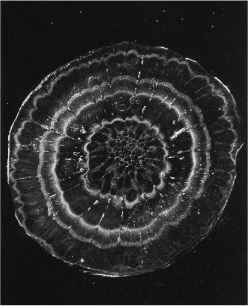
The larger the number of layers the larger the hail and more severe the storm. You can imagine that only a very strong storm with powerful updrafts could sustain large hail. As the hail grows in size it becomes more massive and the force of gravity on them increases. If it remains airborne long enough to grow to the large sizes then the updrafts must have been very powerful to prevent the hail from falling. However, at some point gravity always wins and the hail falls to earth.
Marble sized hail is the most common size and that hail is most often found near the borders of Wyoming, Colorado, and Nebraska. I also read (in my handy atmos handbook) that hail is more common over mountain ranges because the mountains force air upward, and this intensifies the updrafts in the storm. Since Michael is right in the middle of the Rockies up there I wouldn't be surprised if this played into the hail.
View Larger Map
The group wanted to get a bit further west, but they were caught by a big thunderstorm. Michael said the storm started with golf ball sized hail and then there was a lot more marble sized hail following that. I believe they all got to shelter in time not to be too injured, but the whole town had hail damage and the motel that they stayed at last night had broken windows and damaged siding from the hail. In addition, Michael's bicycle fell over during the storm and lots of his stuff got wet in the rain (somehow it was in a small flood or something), so he was hoping it would all dry in the night.
Hail the size that they experienced is relatively uncommon and suggests that the storm that passed over was very large with a strong updraft area. In order to bring the air and water droplets high enough to be frozen the cloud has to extend high into the troposphere where temperatures are very low.
Hail is created when a drop of water turns into an ice pellet. It gets caught in an updraft of the thunderstorm and collides with water droplets which then stick to it and make it grow. It eventually falls again and can either fall to the ground in this state or be caught by another updraft where it can accumulate more volume. The hail can be tossed around in the cloud for a long while and grow in size, thus leading to larger and more damaging hail. As a result the hail grows in layers and if you take a cross section of hail you can see these layers:

The larger the number of layers the larger the hail and more severe the storm. You can imagine that only a very strong storm with powerful updrafts could sustain large hail. As the hail grows in size it becomes more massive and the force of gravity on them increases. If it remains airborne long enough to grow to the large sizes then the updrafts must have been very powerful to prevent the hail from falling. However, at some point gravity always wins and the hail falls to earth.
Marble sized hail is the most common size and that hail is most often found near the borders of Wyoming, Colorado, and Nebraska. I also read (in my handy atmos handbook) that hail is more common over mountain ranges because the mountains force air upward, and this intensifies the updrafts in the storm. Since Michael is right in the middle of the Rockies up there I wouldn't be surprised if this played into the hail.
Sunday, July 20, 2008
Yellowstone- hot springs
Michael called this afternoon to let me know that the group had moved on to West Yellowstone, just in the Montana border in order to do laundry and cook. They are moving north on highway 287 and are hoping to camp along there tonight. Yesterday was a laid back day at camp for Michael and Trevor, and Claire and Calum hitchhiked into the park and saw the northern part of the Loop: The Grand Canyon of the Yellowstone and such. According to his comrades Michael looks too much like "a scary man" to be successful in getting rides now. Oh well, he got to rest and read all day instead.
He sent me some photos of the past few days and I've posted them above. You can click on the slideshow and be taken to my photo account if you would like to see any of them particularly. I'm going to write a short bit about each one below. I have included two that I pulled out of one of my high school papers and have interesting and somewhat sad stories related to what Michael saw.
1. The Grand Tetons: I know very little about these mountains except that they are very pretty and were created during the Laramide Orogeny, the event that created the Rocky Mountains (I'll talk more about this later). If you'd like to know more about Teton geology specifically look here (thanks Wiki!).
2. and 3. Michael's picture of Morning Glory Pool contrasted with a picture from around the 1950's: Michael told me specifically that he was sad after reading a post near the spring. In short people have ruined Morning Glory pool irreparably. It used to be one of the most popular pools in Yellowstone due to its beauty and similarity in color to the beautiful morning glory flowers.
However, because people have thrown debris in there they have plugged the below ground plumbing and the spring is no longer fed with hot enough water to sustain the original color. Thermophillic microscopic life lives in thermal pools at Yellowstone and creates particular colors, which are indicators of the temperature of the pool: 164-145F- Blue, light green; 144-122F -Orange, bright yellow. The lower temperature allows new algae and fungi growth, and the color of the spring has changed to an orange (maybe Michael likes it this way better ;) that is less popular than the original blue color.
A cleaning of Morning Glory in 1950 produced many objects including socks, bath towels, 76 handkerchiefs (to be explained next!), tax tokens, logs, bottles, tin cans, $86.27 in pennies, and $8.10 in other coins. People continue to pollute Morning Glory and sadly coins currently line the walls of the spring.
4. Handkerchief Pool, early 1900's: I included this to elaborate on why the hot springs are so damaged. This photograph has, yes, a ranger holding up a handkerchief about to drop it in a pool.
Many hot springs are connected to others by the underground plumbing. In the past people would place debris into a feature to determine if the water could eject it, for more frequent eruptions, for good luck, for amusement, or for no apparent reason. Rocks, sticks, and other objects can completely block off an opening and stop all water flow. They can also cause a pressure buildup, so the next geyser eruption is sooner and more powerful. The plumbing system can be damaged, sometimes irreparably, because of the extra force in these eruptions.
Clothing was commonly laundered at hot springs and even Old Faithful was used for this chore in the 1880’s because when clothes were washed in Old Faithful, they came out “nice and clean as a …week’s scrubbing.” By doing laundry at springs, people discovered that adding soap, another foreign material, to certain springs would make them erupt (I don't know the chemistry or other particulars of the reaction here). The soaping induced an almost immediate eruption for impatient tourists and almost all geysers were soaped at some point. Soaping induced eruptions that were usually more powerful than normal and more likely to damage the plumbing due to too much force.
There were also handkerchief tricks that were even listed as amusements in tour guides. The most famous of these pools was Handkerchief Pool, though others were used too. Handkerchief pool had particular currents that would suck handkerchiefs in one vent and return them “nice and clean” in another vent soon after. Unfortunately some logs stuffed by careless tourists into the vent of Handkerchief Pool in 1929, plugged this spring. If the handkerchief trick were still allowed today (thank goodness it isn't!), it would not work because the plumbing that allowed for it was destroyed. Sad.
5. Dragonfly: Michael said that this morning there was a dragonfly flitting around. It was cold in the morning so the df was having trouble flying. He picked it up and held it on his hand. His skin's warmth helped it heat so it soon flew off. I think it might be a Black Meadowhawk, but whatever it is it has fantastic wing patterns!
6. Entering Montana: Just the requisite state sign.
Saturday, July 19, 2008
Yellowstone-wildlife
Michael has not been able to call much in the past few days because there is little cell phone service outside a few centers within Yellowstone. He's camping at Madison, on the western side of the park, with the three he's riding with. He told me that he has been unable to see the Artist's Paint Pots because there is some kind of road work going on in that area, but I think he's been able to see some paint pots.
But he has been around the Upper geyser basin, the location of old faithful and other famous springs like Morning Glory Pool, Beehive geyser, etc. And of course the beautiful Old Faithful Inn built around 1900. The lodge used to give bear viewings from the roof when park staff used to feed bears for the tourist interest. The viewing platform was disturbed by earthquakes and is now no longer open to the public for safety reasons. When I was young my favorite thing to do when I got to the inn was in the main entrance hall to look up in the highest rafters for a stuffed bear that was placed there during construction and was somewhat of a mystery. It was very small and hard to see and a fun game to see if I could find it before my brother. But during an earthquake in the last 10 (or so) years it feel from the rafters and is now kept in a museum in Mammoth.
Anyway, back to the wildlife. Perhaps things have changed since last I spoke to him, but he told me that all the wildlife he'd seen was a bison (known as buffalo, but this is a misnomer, they are American Bison) or two. I was in shock. There are usually animal jams galore in Yellowtone, especially in the summer when all sorts of people who have never seen bison or elk or moose. I hope that they will see a bear or coyote before going, but alas I cannot direct the animals. Shrug.
Michael said they did come across a bison skeleton that had been eaten, and he said perhaps by a pack of wolves. I have no idea how he decided this since it could easily have been scavenging bears, coyotes, etc. But the reintroduction of the grey wolf into Yellowstone is something very interesting as a human attempt to help restore the ecosystem. The grey wolf is the top predator in the ecosystem and after they were all killed earlier in the century the ungulate population grew alarmingly. Now having hoards of moose, elk, deer, bison, etc might sound like a good thing, but in fact it is very damaging. When there are too many herbivores the vegetation gets overeaten and they also move outside park boundaries to get enough food. In addition, after the large fires in 1988 and the loss of old growth trees it is important to have new growth plants because without plants' roots there can be problems with erosion.
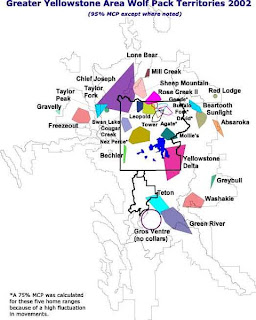
Anyway, the grey wolf reintroduction has gone well. Even though there have been some problems with huge legal battles and later poaching (Local ranchers have been particularly opposed to the reintroduction because they are afraid that the wolves will kill their stock). However, the population has grown from the original 66 wolves in 1995 to somewhere around 325 in 2006. In addition the packs have spread and now populate areas (see map below) and wolves have even been spotted as far south as Colorado and these have been traced to the Yellowstone packs. The park has definitely had benefits such as increased growth of forest and recovery of some species, like red fox, and I believe that there have been fewer problems with preying on farm animals than expected. So, at least in my opinion, this reintroduction has been a success. I doubt Michael will see the wolves on this trip, but if he did that would be a treat indeed!
But he has been around the Upper geyser basin, the location of old faithful and other famous springs like Morning Glory Pool, Beehive geyser, etc. And of course the beautiful Old Faithful Inn built around 1900. The lodge used to give bear viewings from the roof when park staff used to feed bears for the tourist interest. The viewing platform was disturbed by earthquakes and is now no longer open to the public for safety reasons. When I was young my favorite thing to do when I got to the inn was in the main entrance hall to look up in the highest rafters for a stuffed bear that was placed there during construction and was somewhat of a mystery. It was very small and hard to see and a fun game to see if I could find it before my brother. But during an earthquake in the last 10 (or so) years it feel from the rafters and is now kept in a museum in Mammoth.

Anyway, back to the wildlife. Perhaps things have changed since last I spoke to him, but he told me that all the wildlife he'd seen was a bison (known as buffalo, but this is a misnomer, they are American Bison) or two. I was in shock. There are usually animal jams galore in Yellowtone, especially in the summer when all sorts of people who have never seen bison or elk or moose. I hope that they will see a bear or coyote before going, but alas I cannot direct the animals. Shrug.
Michael said they did come across a bison skeleton that had been eaten, and he said perhaps by a pack of wolves. I have no idea how he decided this since it could easily have been scavenging bears, coyotes, etc. But the reintroduction of the grey wolf into Yellowstone is something very interesting as a human attempt to help restore the ecosystem. The grey wolf is the top predator in the ecosystem and after they were all killed earlier in the century the ungulate population grew alarmingly. Now having hoards of moose, elk, deer, bison, etc might sound like a good thing, but in fact it is very damaging. When there are too many herbivores the vegetation gets overeaten and they also move outside park boundaries to get enough food. In addition, after the large fires in 1988 and the loss of old growth trees it is important to have new growth plants because without plants' roots there can be problems with erosion.
Anyway, the grey wolf reintroduction has gone well. Even though there have been some problems with huge legal battles and later poaching (Local ranchers have been particularly opposed to the reintroduction because they are afraid that the wolves will kill their stock). However, the population has grown from the original 66 wolves in 1995 to somewhere around 325 in 2006. In addition the packs have spread and now populate areas (see map below) and wolves have even been spotted as far south as Colorado and these have been traced to the Yellowstone packs. The park has definitely had benefits such as increased growth of forest and recovery of some species, like red fox, and I believe that there have been fewer problems with preying on farm animals than expected. So, at least in my opinion, this reintroduction has been a success. I doubt Michael will see the wolves on this trip, but if he did that would be a treat indeed!

Subscribe to:
Posts (Atom)